-
About us

- Ukrainian Youth Association in Estonia
- Ukrainian art studio “MRIJA”
- Ukrainian folk music ensemble “Dibrova”
- Ukrainian community “Vodohray”
- Children’s reading club “KOLO”
- Ukrainian community "Spohad"
- Cultural club "Kryla" of the "ORFEY" society
- Shared library Spilno_ee
- Ukrainian Society and "Kalyna" Saturday School in Valga
- Prosvita - Ukrainian cultural and educational society
- UKRAINIAN MEDIA DRUZI NGO
- Ukraina Käsitöö Meistrid MTÜ
- Ukrainian society “Vitchyzna”
- Choreographic ensemble “Kolor”
- Ukrainian studio “Kobzaryk”
- Art studio “Anima”
- Stand Up from UA
- Kotygoroško
-
Our team
-
Projects and events
-
Supporting Ukraine
-
Education
-
Culture
-
Festivals
-
All news
-
Contacts
-
Photo




“The Shore of Love”. A book on the history of AUOE
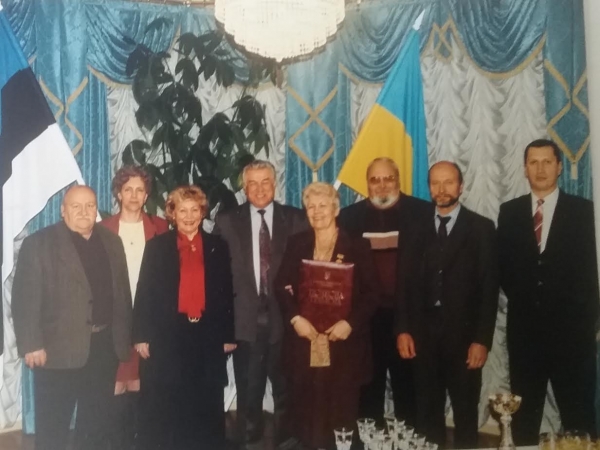
Introduction.
The shore of love… That is how we Ukrainians, now living in Estonia on the shore of the Gulf of Finland, often call the place where we live.
Here each of us has found a home and a destiny.
Describing the life of today’s Ukrainian diaspora in Estonia is both simple and difficult. Simple, because we have all witnessed what has happened to us and the country; difficult, because every fate and event has its own particular sides that are sometimes hard to describe. We wrote the book you are holding together with you, the reader. There is no deep analysis here, but there is the energy of our hearts.
So we invite you to delve together into the history of the founding and development of the Ukrainian association that became known as the Association of Ukrainian Organisations in Estonia, whose beginning dates to 2000.
Pages from the history of the Ukrainian community in Estonia.
A person or family who for some reason leaves their native land and settles far beyond it acquires the status of a foreigner belonging to a group of people united by language and culture. Such a group is usually called a diaspora.
In the early 2000s there were about 30,000 of us Ukrainians in Estonia. Today this number is changing dramatically every day.
The history of relations between Ukraine and Estonia began in ancient times, when in 1030 Prince Yaroslav the Wise of Kyiv founded the town of Yuriev on the site of an ancient hillfort; it was later called Dorpat and then Tartu.
The fates of many natives of Ukraine in mid-19th-century Estonia were linked to the University of Tartu, as they were mainly students and lecturers of the University of Dorpat (now Tartu). From the 1880s the number of students grew significantly, and young people cut off from their homeland felt the need to unite.
So the first Ukrainian society in Estonia was founded in November 1898 – an illegal organisation called the “Dorpat Ukrainian Student Hromada”. Its initiator and first leader was the journalist Fedir Matushevskyi. The organisation advocated national-territorial autonomy for Ukraine and the right to education, literature and press in Ukrainian.
The society had a drama group, a women’s choir and a small library. Although the Hromada was not very large, it became the centre of Ukrainian cultural and educational life in Tartu.
Lesya Ukrainka herself once visited the student group while staying with her brother. On 20 February 1900 (Old Style), returning from St Petersburg to Ukraine, Lesya Ukrainka visited Dorpat (Tartu), where her brother Mykhailo Kosach, a Privatdozent at the University of Dorpat, lived at the time. She stayed briefly, until 1 March. Used to valuing the relatively calm periods her illness allowed her (bone tuberculosis confined her to bed for months on end), she did not sit idle at her brother’s either – she prepared a paper on Heine, proofread her works and wrote letters. The University of Tartu Library still holds the first edition of her poetry collection “Dumy i mrii” (“Thoughts and Dreams”), probably obtained with Mykhailo Kosach’s help. To commemorate Lesya Ukrainka’s visit to Estonia, the Embassy of Ukraine in Estonia unveiled a memorial plaque on 25 February 2001 on the façade of the house in Tartu where the great poet stayed.
According to researchers, the largest influx of Ukrainians to the Baltic states began after the Second World War. It was caused by the arrival of many young workers at all-Union construction projects and by the planned assignment of university graduates to leading industrial enterprises, social institutions and research institutes.
As the Baltic republics remained centres of relatively greater democratic freedom in the former Soviet Union, the Ukrainian creative intelligentsia also came here. Finally, many repressed Ukrainians were not allowed to return home after serving their sentences in prison or exile, so they settled elsewhere, including in Estonia.
In recent decades the country’s Ukrainian community has grown through labour migrants.
Most Ukrainians living outside their homeland have sought and still seek contact within their diaspora, and that is perfectly natural. Estonia – a peaceful and friendly country – welcomes us with an open heart and tries at state level to support every national cultural association.
In November 1988 Ukrainians in Estonia founded their society. It was called the “Ukrainian Community Society” (Ukrainske zemliatstvo) and became, in a sense, the successor of the Dorpat Ukrainian Student Hromada (late 19th – early 20th century); it supported the independence movements of Estonia and Ukraine.
Ukraina Kaasmaalaskond Eestis (the Ukrainian Community Society of Estonia) was the centre of Ukrainian life in Estonia from the late 1980s to the mid-1990s. Its main task was to set Ukrainians apart from the Russian-speaking population as a distinct nation and unite them to preserve their national identity.
With the founding of the Ukrainian Community Society, the formation of the Ukrainian diaspora in Estonia began.
In 1991 the Ukrainian Greek Catholic Church was registered, and from the mid-1990s Ukrainian organisations began to be set up in Estonia’s regions – in Narva, Sillamäe, Maardu, Jõhvi and other towns.
The societies’ main focus is cultural and educational, and their aim was and remains to preserve national traditions and language among local Ukrainians and to promote Ukrainian culture in Estonian society.
The Association of Ukrainian Organisations in Estonia.
The small societies already set up by then in various Estonian towns could not function successfully without a coordinating organisation...
The process of creating a centre to unite the newly founded regional societies in early 2000 is described by a direct participant, the head of the society “Prosvita”, Mrs Oksana Mamutova:
“Let me start by saying that in 1997 the society “Prosvita” was officially registered, first headed by Olha Horianska. Unfortunately, our association did not have close ties with the Ukrainian Community Society that existed at the time, but we received active help from the Association of National Minorities of Estonia “Lyra”, headed by Lidia Kõlvart.
Somewhere at the end of 1999 we met Oleh Mazurenko, who headed the Society of Citizens of Ukraine. In conversation with me, Oleh suggested that we unite under that name. The idea of creating an umbrella organisation was interesting in itself, but personally I did not like the structure, as it limited access for compatriots who were not Ukrainian citizens. At the same time I met Mr Vlad Reznichenko, who also supported the idea of uniting the communities but was able to suggest a somewhat different name – the Association of Ukrainian Organisations in Estonia.
Creating such a coordinating centre was very relevant at the time, as newly founded societies had begun to work actively both in Tallinn and in other Estonian towns, including the Tallinn society “Prosvita”, the Ukrainian Chamber of Commerce and Industry, the dance ensemble “Kolor” and the sports club “GALS”; the Maardu society “Stozhary” was being approved, and the Ukrainian society “Vodohrai” in Sillamäe had begun active work. Vlad Reznichenko offered a room for meetings. It was a small but cosy space at Kopli 10, Tallinn. Activists renovated the room and simply called it the Ukrainian house. In early February 2000 we invited the Ambassador Plenipotentiary of Ukraine to Estonia Mykola Makarevych and the heads of the newly founded Ukrainian societies to the house. So on 7 February 2000, in the presence of distinguished guests, society heads and community members, a protocol was signed and a declaration of intent was announced to create a governing organisation uniting Ukrainian societies in Estonia under the name Association of Ukrainian Organisations in Estonia. The Association was to be led by one of the heads of its member societies after election by the Board members.
On 30 May 2000 the Association of Ukrainian Organisations in Estonia received official status, and Oksana Mamutova was elected the first Chair of the Board, or President, of AUOE.
Since 30 May 2000 the Association of Ukrainian Organisations in Estonia has coordinated the work of the societies that joined it voluntarily on the basis of an application.
The Association’s day-to-day work is managed by a Coordination Council, or Board, made up of the heads of the communities. According to the Statutes, it is the Board that decides on funding and reporting to the state, the association’s internal and external relations and, above all, the content and directions of AUOE’s work in Estonia and beyond.
AUOE is essentially the first mono-cultural association in Estonia; its emergence significantly raised the standing of the Ukrainian diaspora in Estonian society, and after just one year of work the Cabinet of Ministers of Ukraine awarded the association a Certificate of Honour.
Over AUOE’s 20-year history its Board has been chaired by Oksana Mamutova, Anatolii Voropai, Vladyslav Reznichenko and Volodymyr Palamar.
Since 2000 the Association has gradually grown, and as of 01.01.2020 its members are:
- Centre of Ukrainian culture in Estonia “Prosvita”, Tallinn (heads: Oksana Mamutova, Inna Karaulshchykova)
- Ukrainian community society “Vodohrai”, Sillamäe (head: Larysa Zhytnyk) – associate member
- Ukrainian Youth Association in Estonia, Tallinn, Tartu (head: Volodymyr Palamar)
- Ukrainian community society “Vitchyzna”, Pärnu (head: Liudmyla Fainytska)
- Creative association “Orpheus”, Tapa (head: Liubov Laur)
- Creative association “Koit”, Tapa (head: Viacheslav Reznichenko)
- Dance ensemble “Kolor”, Tallinn (head: Nina Hets)
- Creative studio “Mriia”, Tallinn (head: Olha Horianska)
- Ukrainian community society of Paide “Spohad” (head: Vilina Hange)
- Music group “Light and Shadows” (head: Mykola Rybchenko)
- Ukrainian Registered Cossacks of Estonia, Tallinn (head: Valerii Hrynko)
- Society “Chervona Ruta”, Tapa (head: Tetiana Chuvpylo)
- Instrumental ensemble “Melodiia”, Paldiski (head: Ivan Shchoholiev)
- Ukrainian society and Saturday school “Kalyna”, Valga (head: Ruslana Dovha)
- AUOE Ukrainian Sunday school “Nadiia” (director V. Palamar)