-
About us

- Ukrainian Youth Association in Estonia
- Ukrainian art studio “MRIJA”
- Ukrainian folk music ensemble “Dibrova”
- Ukrainian community “Vodohray”
- Children’s reading club “KOLO”
- Ukrainian community "Spohad"
- Cultural club "Kryla" of the "ORFEY" society
- Shared library Spilno_ee
- Ukrainian Society and "Kalyna" Saturday School in Valga
- Prosvita - Ukrainian cultural and educational society
- UKRAINIAN MEDIA DRUZI NGO
- Ukraina Käsitöö Meistrid MTÜ
- Ukrainian society “Vitchyzna”
- Choreographic ensemble “Kolor”
- Ukrainian studio “Kobzaryk”
- Art studio “Anima”
- Stand Up from UA
- Kotygoroško
-
Our team
-
Projects and events
-
Supporting Ukraine
-
Education
-
Culture
-
Festivals
-
All news
-
Contacts
-
Logo
-
Photo


Books in our life
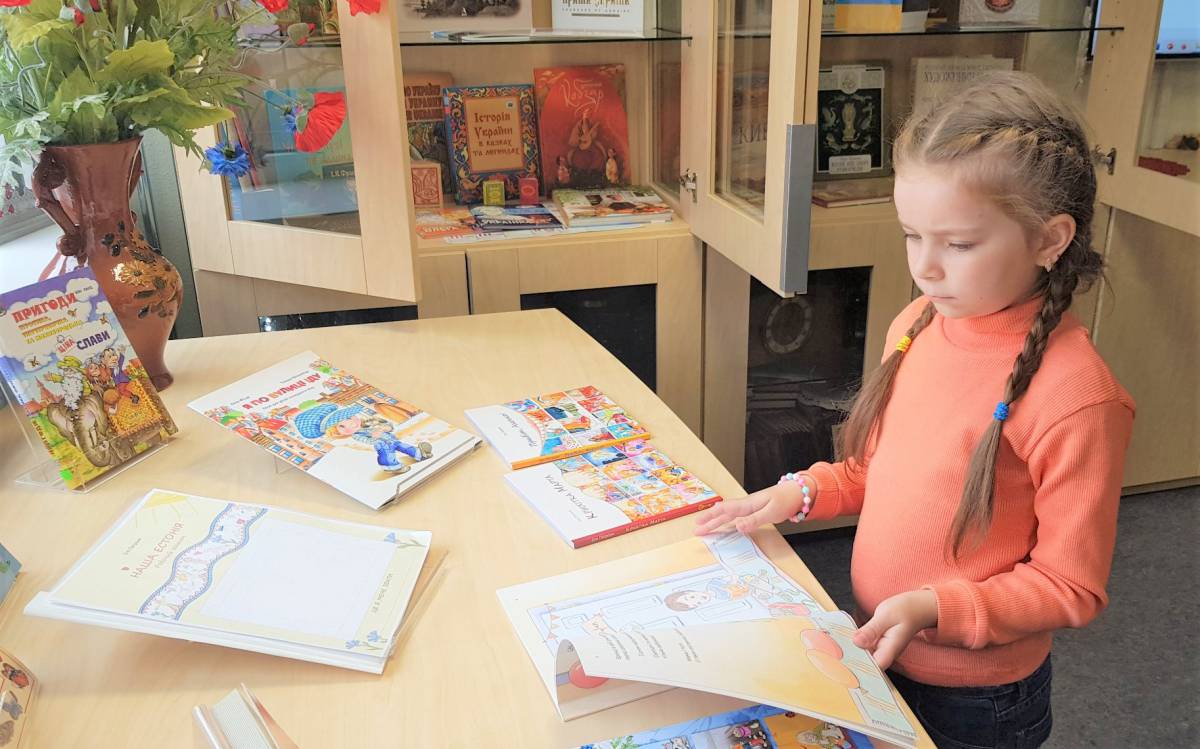
We can call a book many things, but its meaning and role in our lives remain unchanged: a book is a treasury of knowledge, a book shapes one’s worldview, a book teaches, a book heals, a book gives us pleasure and rest. A book is the main witness to the history of a state and its people… Among the most valuable assets of Ukrainian national societies formed all over the world, including in Estonia, are their libraries.
Today the library of the Ukrainian community society “Vodohrai” in Sillamäe has about 400 volumes. As 2022 has been declared the Year of Libraries, the leadership of “Vodohrai” decided to hold a series of events to acquaint every compatriot living in the town and region with the library’s collection.
In cooperation with the town library, the first of them was held on 20 May: a large book exhibition, “Books – Treasures of Humanity. Ukrainian Book Gems”, presenting the most valuable editions from different years on the history and art of the state, fiction and children’s books. Besides books by Ukrainian and world authors, there were Ukrainian translations of the Estonian epic “Kalevipoeg” (The Son of Kalev), Estonian poets for children and books by well-known Estonian authors.
Participants in this first book forum included both compatriots who have lived in Estonia for many years and those forced to flee who came to Estonia alone or with children seeking refuge from the war…
It was nice to see the young faces of boys and girls among those present, who also listened attentively to the speakers and even asked questions on the topic…
As a professional librarian and former head of the reading room of the Cherkasy Research Library, I was invited by the society to add my perspective and knowledge to the conversation about books. Besides explaining how a library collection is organised scientifically and how we specialists must find our way around it and help readers find what they need, I told how the book was an object of political persecution, when works by well-known progressive authors were banned. We librarians had to hide the odd collections of poetry by authors such as Vasyl Stus and Lina Kostenko in drawers and secretly lend them to trusted people, for which I was summoned to the KGB a couple of times, and every literary evening devoted to Vasyl Symonenko (who lived and worked in Cherkasy) was invariably checked for the permissibility of what was said…
Today this seems wild and impossible to us, yet for 70 years libraries lived and worked in exactly such conditions.
Today books face a different danger – the availability of information on the internet… Readers now more often choose a shorter and faster route to the information they need – they use Google, e-libraries and similar tools, so coming to a library and leafing through a paper book has become a luxury for many who want to save time.
Children’s books still have the edge here, because besides text they have beautiful colourful illustrations that quite often hold a child’s attention.
At this time, given the large number of people forced to flee Ukraine, Ukrainian societies together with the Estonian state are concerned precisely with supplying libraries with Ukrainian children’s literature, as a third of more than 20,000 refugees are children. Small collections of Ukrainian-language literature, including children’s books, are now being created at the central libraries of Estonian towns. Library staff are also working on this together with the leadership of “Vodohrai”.
The next events in the “Books – Treasures of Humanity” series at the Ukrainian society “Vodohrai” will be devoted to meetings with authors of children’s books, including the writer Marko Teren and poets whose works have already been published as books.
As a participant in the event held this Friday, I am very grateful to those present who listened attentively to the poetry of Lina Kostenko, our Ukrainian classic; one boy even eagerly asked me where the writer lives now and when she first started writing poems, and then hugged me warmly, thanking me for my talk. For the first time I also read my own poems to a wide audience – poems that, as often happens to us, were born in special circumstances in a person who had never written poetry before.
It was very nice to receive as a gift books translated from Estonian by local author and journalist Mykola Pavlenko:
“Kastepiisk ristikulehel” (A Dewdrop on a Clover Leaf) and “Naergem koos” (Let’s Laugh Together).
At the end, as is customary in the Ukrainian community, there was a warm, sincere and delicious gathering with traditional varenyky, salo and treats.
With tears in their eyes, our compatriots remembered the homes they had left behind and shared memories of their home regions, and we tried to comfort them at least a little with a kind word…
Mrs Larysa Zhytnyk, head of the society – which turned 23 these very days – told people about the society’s upcoming events: group trips to the festival “Flowers of Ukraine”, Sunday school classes and meetings with interesting people…
She also stressed how much support the Estonian state is giving Ukraine, for which each of us should be grateful to every person and every organisation that shares whatever they can to support our people.
The organisers sincerely thank everyone who took part and present a photo album of the event, which you can view in the album.
How important it is for a person to feel part of a family – small, or as large as a community society. It is this that today saves many from despair and hopelessness and gives hope that together we will get through everything, overcome everything and certainly WIN! GLORY TO UKRAINE!
Liubov Laur.