-
About us

- Ukrainian Youth Association in Estonia
- Ukrainian art studio “MRIJA”
- Ukrainian folk music ensemble “Dibrova”
- Ukrainian community “Vodohray”
- Children’s reading club “KOLO”
- Ukrainian community "Spohad"
- Cultural club "Kryla" of the "ORFEY" society
- Shared library Spilno_ee
- Ukrainian Society and "Kalyna" Saturday School in Valga
- Prosvita - Ukrainian cultural and educational society
- UKRAINIAN MEDIA DRUZI NGO
- Ukraina Käsitöö Meistrid MTÜ
- Ukrainian society “Vitchyzna”
- Choreographic ensemble “Kolor”
- Ukrainian studio “Kobzaryk”
- Art studio “Anima”
- Stand Up from UA
- Kotygoroško
-
Our team
-
Projects and events
-
Supporting Ukraine
-
Education
-
Culture
-
Festivals
-
All news
-
Contacts
-
Photo




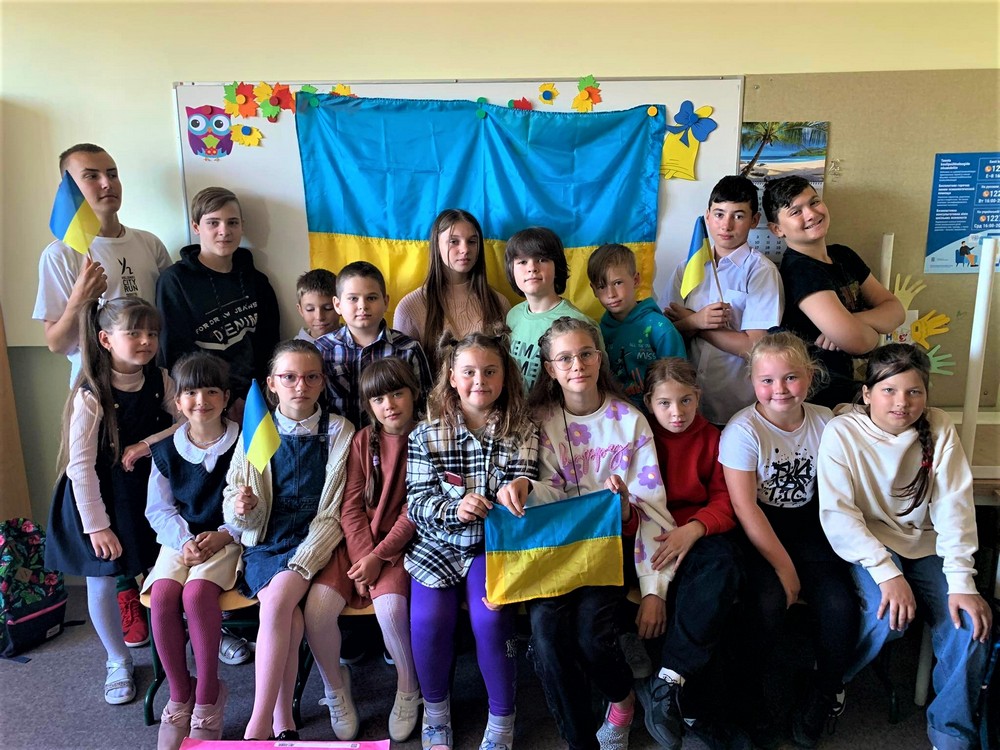
Of more than 15,000 school-age children forced to flee Ukraine, over 50 ended up in the town of Tapa. Here the children’s families found shelter, and here the pupils were to continue their studies.
The Estonian state very quickly solved the question of how refugee children would continue their education in the Estonian school system. Tapa Parish coped with this task just as successfully, and today not a single child living in our town and region has been left without the state’s attention. Free breakfasts and lunches have been arranged for the children, and every child received all the necessary learning equipment and supplies in time.
Tapa has two schools for children – Tapa Gümnaasium (Pargi 12, Tapa 45106) and the so-called immersion school (Tapa Keelekümbluskool, Nooruse 2, Tapa 45106) – an almost unique school where, by immersing themselves in a subject-based language environment, a child with another mother tongue quickly learns the state language.
In both schools the language of instruction is the state language, Estonian.
However, from 1 September 2022, the management of the gymnasium led by Klaire Uustalu created a kind of educational precedent: several age-combined groups (grades 1–4, 5–9 and 10–12) were given the opportunity to study some subjects in their native Ukrainian.
The school management found among the refugees people with specialised training who could teach in the primary grades and teach core subjects (language, literature, history, geography, biology) in Ukrainian.
Today the gymnasium has more than 500 pupils, including 31 from Ukraine.
Pupils from Ukraine who have enrolled in and attend the immersion school (Tapa Keelekümbluskool) – currently 21 – can study Estonian intensively, while Ukrainian language and culture are also taught there in their native language. The school’s director Naima Sild has talked with every parent and child, having first obtained their consent.
Before writing this piece on the schooling of Ukrainian children, I visited the gymnasium and was kindly received by its director Klaire Uustalu, and I spoke with the director of the immersion school by phone. Both heads are very seriously engaged in organising education for children forced to flee and try to give every support to pupils, teachers and parents.
School psychologists work with the Ukrainian children.
The children’s creative and sporting abilities are also supported and developed at the town’s sports complex, the Tapa music school and the town’s cultural centre.
It is pleasing to note that Ukrainian children are finding friends among their Estonian-speaking peers, making it easier to adapt to a new language environment.
As head of the society “Orpheus”, I offered the heads of the town’s schools the Ukrainian community’s support in cultural and educational work with pupils and in organising themed concerts, talks and other events.
On behalf of the Association of Ukrainian Organisations in Estonia, which I represent, I sincerely thank the heads of the schools and childcare institutions of our town and parish, schoolteachers and kindergarten teachers for their attention and incredible support for my compatriots who were forced to leave their homes and seek protection abroad. This story will remain in the memory and fate of each of them. Who knows how the future life of each family and child will turn out, but their time in Estonia and their immersion in another language and culture will never be erased from memory.
Good luck to you, dear children, on your challenging learning journey – be worthy of your people and your country, carry your language and culture with pride, but respect the language and traditions of the people and the state that has sheltered you!!!