-
About us

- Ukrainian Youth Association in Estonia
- Ukrainian art studio “MRIJA”
- Ukrainian folk music ensemble “Dibrova”
- Ukrainian community “Vodohray”
- Children’s reading club “KOLO”
- Ukrainian community "Spohad"
- Cultural club "Kryla" of the "ORFEY" society
- Shared library Spilno_ee
- Ukrainian Society and "Kalyna" Saturday School in Valga
- Prosvita - Ukrainian cultural and educational society
- UKRAINIAN MEDIA DRUZI NGO
- Ukraina Käsitöö Meistrid MTÜ
- Ukrainian society “Vitchyzna”
- Choreographic ensemble “Kolor”
- Ukrainian studio “Kobzaryk”
- Art studio “Anima”
- Stand Up from UA
- Kotygoroško
-
Our team
-
Projects and events
-
Supporting Ukraine
-
Education
-
Culture
-
Festivals
-
All news
-
Contacts
-
Logo
-
Photo


Augsburg – more than a forum: unity, community experience and new partnerships
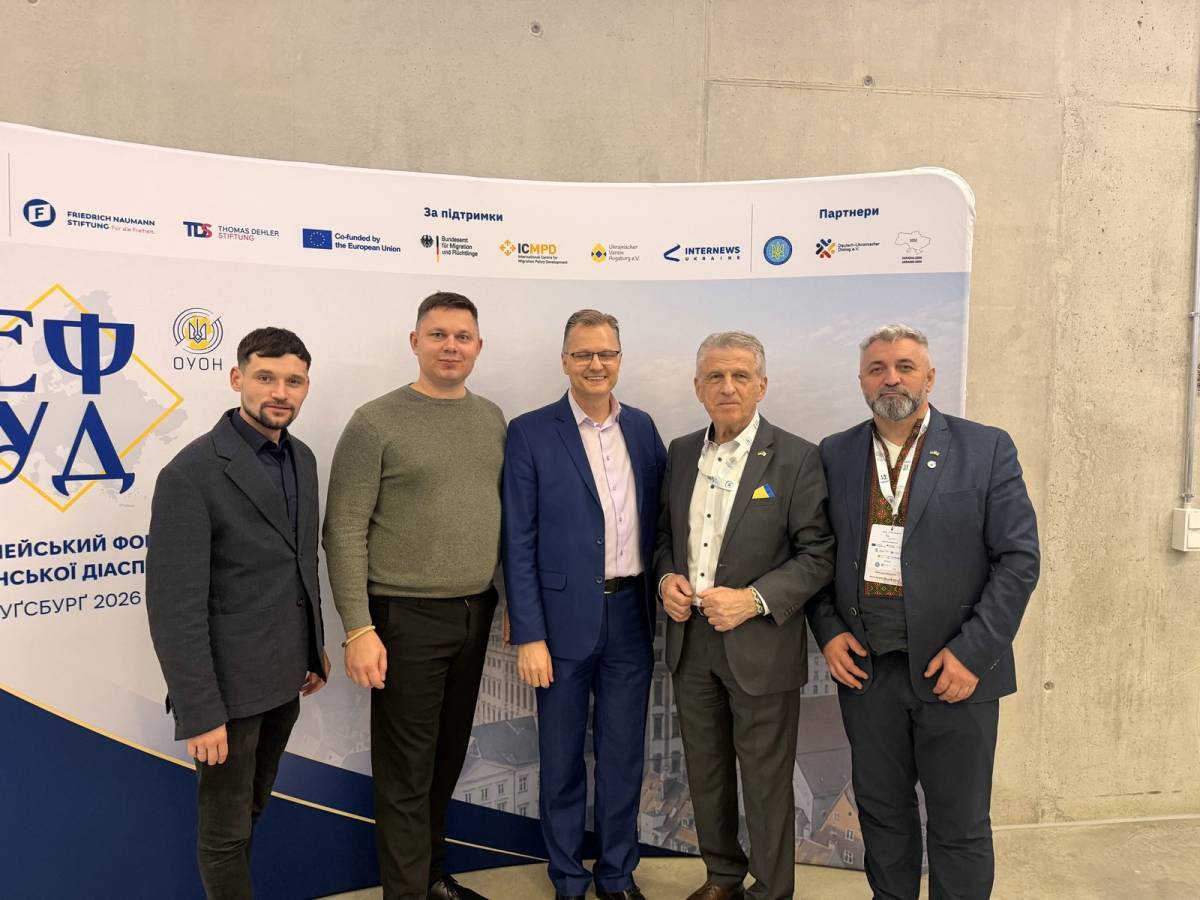
The second part of the story about the Chairman of the Board of the Association of Ukrainian Organisations in Estonia at the European Forum of the Ukrainian Diaspora «Augsburg 2026». The first part is here.
In the previous article we wrote about the European Forum of the Ukrainian Diaspora in Augsburg, its participants and the main topics of discussion. Now I would like to share another side of this trip – what happened between the official sessions, in personal meetings, conversations and exchanges of experience.
Every day in Augsburg was extremely busy. The working programme started at 9 a.m., and conversations with colleagues often went on until midnight. That is no exaggeration. After the official part ended, equally important conversations began – about the life of Ukrainian communities, their opportunities, prospects for joint work, and the problems and challenges organisations in different countries face today.
It is in such informal meetings that ideas are often born, new contacts appear and partnerships form that later grow into concrete projects.
Different countries, different experience, one common goal
One of the most important questions that kept coming up in our conversations was how to build effective cooperation between Ukrainian communities and organisations – especially when they hold different views, misunderstand each other or are even in conflict.
We must not close our eyes to the problems. Ukrainian civic organisations today work in a difficult information environment. russian propaganda and disinformation try to influence not only the societies of host countries but also Ukrainian communities abroad, provoking division, mistrust and confrontation.
On top of that come internal organisational difficulties, different approaches to management, and competition for resources, funding, people and the attention of state institutions.
In my view, this is exactly why such international meetings are so important.
Every community has its own history, experience, management model, traditions and particular challenges. Ukrainian organisations in Northern Europe – Finland, Estonia and other countries – work in one set of conditions, communities in Central Europe or North America in another.
In some places the main focus is on integrating newly arrived Ukrainians; elsewhere it is on preserving the traditional diaspora, education, culture, representing Ukrainians before state institutions or organising humanitarian aid.
There is no single universal model that works equally well everywhere.
But there is something that must unite us all: regardless of country, organisational specifics or personal differences, we must remember what we are working for.
Our main goal is to help Ukraine, support Ukrainians, protect Ukrainian identity and represent the interests of our state abroad.
We cannot allow everyday management problems, misunderstandings or personal ambitions to push that goal into the background.
Leadership, responsibility and managing large Ukrainian communities
For me, a particularly interesting session was the panel with the leaders of the Ukrainian World Congress and the European Congress of Ukrainians – Paul Grod and Bohdan Rajčinec.
These are leaders with an enormous amount of organisational work behind them, coordinating many communities, volunteers and representatives of different countries and fields.
Managing such structures is not easy at all. You have to take into account the interests of different organisations, listen to people, find common solutions, motivate volunteers, share responsibility and at the same time keep a common strategic direction.
It is especially important to understand that Ukrainian communities are made up of people who give their personal time, energy and often their own resources to civic work. Their motivation, trust and sense of belonging to a common cause are among the most important resources of the Ukrainian movement abroad.
I would like to express my deep gratitude and respect to Paul Grod and Bohdan Rajčinec for their work, responsibility and contribution to Ukrainian organised life around the world.
I also want to thank everyone who today leads Ukrainian organisations, creates schools, develops cultural centres, supports youth initiatives, brings people together and does their work every day.
This work often goes unnoticed by the wider public, yet it is what keeps the Ukrainian presence alive in many countries.
Ukrainian youth – our future, already today
It was a special pleasure to see how the Ukrainian youth movement in Europe is developing.
The panel dedicated to young people left a very positive impression on me. We heard educated, smart, active and promising young Ukrainians who are well versed in politics, economics and international relations, know their rights and can put their knowledge into practice.
These are no longer simply young people taking part in civic events. This is a new generation of Ukrainian leaders, able to represent Ukraine, hold a dialogue with state institutions, develop international partnerships and take responsibility for the future of their communities.
It was especially good to see youth initiatives becoming a full part of the international Ukrainian civic movement.
I am convinced that we must not just talk about the need to involve young people, but genuinely give them opportunities, trust, responsibility and room to grow.
It is the young who will continue our work – with their own knowledge, views and new tools.
A feeling of home far from Estonia
You know, during this meeting I caught myself thinking more than once that I felt at home.
Ukrainian spoken all around, Ukrainian flags, embroidered shirts, Ukrainian soldiers and public figures, familiar and new faces, shared thoughts, worries and care for Ukraine.
For a while you are completely immersed in your Ukrainian world, your own identity, culture and a community of people for whom Ukraine remains the most important value, wherever they live today.
At the same time you realise how diverse Ukrainians abroad are. Everyone has their own story, path, country and circumstances, but we are united by common origin, culture, language and responsibility to Ukraine.
I apologise in advance to everyone I have not mentioned here or did not manage to talk to in person. There were so many meetings, conversations and new acquaintances in those days that it is physically impossible to mention everyone. But this trip and the people I met will stay in my memory for a long time.
An important step for the Association of Ukrainian Organisations in Estonia
One of the most important events for our organisation was the invitation for the Association of Ukrainian Organisations in Estonia to consider becoming an associate member of the European Congress of Ukrainians.
For the Association this is an important prospect.
International cooperation, representing the interests of the Ukrainian community in Estonia, exchanging experience, taking part in joint European initiatives and being directly involved in the pan-European Ukrainian civic movement – all of this matters greatly for the further development of our work.
We are sincerely grateful for this offer and for the trust.
Of course, the question will be discussed by the Board of the Association, which has to consider all aspects and take the appropriate decision.
I believe it is important for the Ukrainian community of Estonia to be an active part of the European Ukrainian community while keeping its own independence, experience and established traditions.
Munich: memory that unites generations
The last day before returning home was also very full and had a special symbolic meaning.
In Munich we visited the grave of Stepan Bandera and his associates.
On behalf of the forum participants we laid flowers, honoured the memory of Ukrainian public figures and sang Ukrainian songs.
It was a moment to reflect on our history, the struggle for independence and the people who devoted their lives to the idea of Ukrainian statehood.
Special thanks to our friend Andrii Nesmachnyi, who showed us the burial places of prominent Ukrainians cared for by the Ukrainian community of Munich and told us about their lives and work.
Such places are extremely important for preserving historical memory. Our history did not begin today, and the struggle for Ukraine's freedom and independence has deep historical roots.
After that we visited the Ukrainian Greek Catholic church in Munich, attended the Divine Liturgy, talked with the clergy and called in at the Ukrainian House next to the church.
There, genuine Ukrainian hospitality and cuisine were waiting for us – borscht and varenyky that were simply delicious!
You value such moments especially far from home. They remind you that the Ukrainian community is not only organisations and official structures, but above all people, traditions, faith, mutual support and a sense of home.
Unity is our strength and the guarantee of our future
Time flew by incredibly fast. After busy days, new acquaintances, conversations and agreements, it was time to return home – to work, family and everyday civic duties.
Once again I sincerely thank the organisers of the European Forum of the Ukrainian Diaspora, the European Congress of Ukrainians, the Association of Ukrainian Organisations in Germany, personally Rostyslav Sukennyk, Kateryna Matei and all the volunteers who made this meeting possible.
I thank every forum participant for their openness, communication, exchange of experience, new ideas and willingness to work together.
For me this trip was not just participation in an international event, but another chance to see how important personal contacts, mutual respect and the ability to listen to each other are.
We may live in different countries, organise civic life in different ways and see different solutions to problems. But we have no right to forget what matters most.
Today Ukraine is waging an extremely hard struggle against russian aggression, war and genocidal acts against the Ukrainian people. And each of us, wherever we live, must do everything possible to support our state and Ukrainians.
Unity does not mean that everyone has to think the same. Unity means that we are able to respect each other, find common ground and work for a common goal.
I am convinced that this kind of unity is one of the key factors of our victory and of Ukraine's future.
Thank you once again for the invitation, the hospitality and the opportunity to be part of this great Ukrainian gathering.
Until new meetings, joint initiatives and Ukraine's victory!
Slava Ukraini!
More photos are in the album.
Sources: European Congress of Ukrainians; Ukrainian World Congress; Association of Ukrainian Organisations in Germany — «Augsburg 2026» forum; Ukrinform — Paul Grod, President of the Ukrainian World Congress (in Ukrainian).
Volodymyr Palamar, Chairman of the Board of the Association of Ukrainian Organisations in Estonia